Wednesday, 3 April 2013

Free-range pork, home delivery - YARRA-PIGS

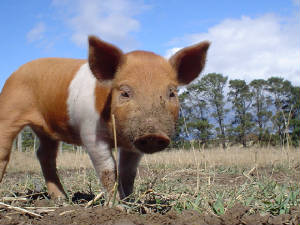
coco.jpg 


a ginger saddle-back piglett, 

about 4 weeks old

Hello & Welcome to my site. Are looking to buy a suckling pig? A pig bred & GROWN free range? A pig free of hormones, steroids and that have not eaten their own dropping and their siblings tails? Look no further!!! I am proud to be a free range suckling pig farmer.

And I can supply you with a tasty piglet from 6kg-12kg ready to cook!

I can even have it delivered to your door if your in Melbourne. 


About Yarra Pigs - Free Range.

We produce suckling piglets all year round. Located in the heart of the Yarra Valley in Dixons Creek/Yarra Glen. My herd of Saddle back cross sows, Berkshire Boar and recently added new Large Black sows. Our marketing is aimed at 100% Meat production. 

The meat is very much sought after, There are not many farmers out there like myself that raise pigs as I do. it's also quite hard to find someone that supplies suckling pigs! But your in luck today !
Currently being sold at Healesville Organic market most Saturdays and at Kinglake Produce & Artisan Market once a month. Last year 'Yarrapigs Pork" featured on many local winery restaurant menus in the Yarra Valley and in Melbourne.
To order a suckling pig is easy:

Please email, phone or text an order through.

My suckling pigs are all processed in the correct manner both tagged and stamped. Transported in refridgerated trucks to your destined Butcher shop or restuarant.
The pigs are sold as a whole piece, including the head. They are dressed (hair & insides removed) and ready for spit roasting!  
Restaurants will have their suckling pigs delivered buy a refridgerated van.
If you are a private buyer a deposit is required apon ordering and balance may be paid apon pick up, or upon delivery booking. Pick up is required from our local butcher shop or you may choose delivery to your door for $44.00 .
Suckling Pig Prices Vary With Season & Stock 6-12kg pig Price Range $180-220.
For current prices please email yarrapigs@live.com.au with the weight required.
XXXXXXXXXXXXXXXXX
 

Packaged Pork Cuts

I sell my pork via my FACEBOOK PAGE YarraPigs Free Range Pork I sell it mainly in cryvacc packs, but freezer bags are a cheaper option. The pork is sold fresh or Frozen.
Cuts available : Pork Chops, Cutlets, Roasts, Spare Ribs, Pork Belly, Pork Racks, Kidneys, Trotter & Hocks.
Private Orders can be made, Cut & Packaged from $15/kg< ORDER NOW!

Edible seaweed - Wikipedia

Edible seaweed - Wikipedia


Roasted sheets of nori are used to wrap sushi.
Edible seaweed are algae that can be eaten or used in the preparation of food. They may belong to one of several groups of multicellular algae: the red algae, green algae, and brown algae. Seaweeds are used extensively as food in coastal cuisines around the world. Seaweed has been a part of diets in China, Japan, and Korea since prehistoric times.[1] Seaweed is also consumed in many traditional European societies, especially in northern and western Ireland, Wales (see Laver), Iceland and western Norway. Seaweed is also eaten in some coastal parts of South West England[2] and the Atlantic coast of France as well as Nova Scotia and Newfoundland. The Māori people of New Zealand traditionally used a few species of red and green seaweed.[3] Most edible seaweeds are marine algae as most freshwater algae are toxic. While marine algae are not toxic, some do contain acids that irritate the digestion canal, while some others can have a laxative and electrolyte balancing effect.[4] Japan consumes no fewer than 7 types of seaweed identified by name, and the general term for seaweed is used primarily for science and not in menus. Seaweed contains high levels of iodine relative to other foods.[5] In the Philippines, Tiwi, Albay residents discovered a new pancit or noodles made from seaweed, which can be cooked into pancit canton, pancit luglug, spaghetti or carbonara and is claimed to have health benefits such as being rich in calcium, magnesium and iodine.[6]
In some parts of Asia, nori 海苔 (in Japan), zicai 紫菜 (in China), and gim 김 (in Korea) are sheets of the dried red alga Porphyra and are used in soups or to wrap sushi or onigiri. Chondrus crispus (commonly known as Irish moss) is another red alga used in producing various food additives, along with Kappaphycus and various gigartinoid seaweeds.

Seaweeds are also harvested or cultivated for the extraction of alginate, agar and carrageenan, gelatinous substances collectively known as hydrocolloids or phycocolloids. Hydrocolloids have attained commercial significance, especially in food production as food additives.[7] The food industry exploits the gelling, water-retention, emulsifying and other physical properties of these hydrocolloids.

Polysaccharides in seaweed may be metabolized in humans through the action of bacterial gut enzymes. Research has failed to find such enzymes in North-American population, while being frequent in Japanese population.[8]

[edit] Common edible seaweeds

Common edible seaweeds[9] include:

[edit] See also

[edit] References

  1. ^ "Seaweed as Human Food". Michael Guiry's Seaweed Site. Retrieved 2011-11-11.
  2. ^ "Spotlight presenters in a lather over laver". BBC. 2005-05-25. Retrieved 2011-11-11.
  3. ^ "Kai Recipe's used by Kawhia Maori & Early Pioneers". Kawhia.maori.nz. Retrieved 2011-11-11.
  4. ^ Wiseman, John SAS Survival Handbook
  5. ^ "Micronutrient Information Center: Iodine". Oregon State University: Linus Pauling Institute. Retrieved 2011-11-11.
  6. ^ "Albay folk promote seaweed ‘pansit’". ABS-CBN Regional Network Group. 2008-04-08. Retrieved 2009-08-04.
  7. ^ Round F.E. 1962 The Biology of the Algae. Edward Arnold Ltd.
  8. ^ Hehemann, Jan-Hendrik; Correc, Gaëlle, Barbeyron, Tristan, Helbert, William, Czjzek, Mirjam, Michel, Gurvan (8 April 2010). "Transfer of carbohydrate-active enzymes from marine bacteria to Japanese gut microbiota". Nature 464 (7290): 908–912. doi:10.1038/nature08937.
  9. ^ Harrison, M. (2008). "Edible Seaweeds around the British Isles". Wild Food School. Retrieved 2011-11-11.

[edit] External links

How to Make Sauerkraut

How to Make Sauerkraut

Sauerkraut, sour cabbage, is a german lacto fermented cabbage dish. In the 18th Century Captain James Cook used sauerkraut to prevent the death of his sailors from scurvy but Germany’s sauerkraut is actually a version of chinese kraut, brought to Europe by the hoards of Gengis Khan.
Raw cabbage is implicated in depressed thyroid functioning, while fermented cabbage and other vegetables provide many health benefits and should not be under estimated for their healing powers. Sally Fallon in her book, Nourishing Traditions provides some excellent instructions on the fermentation of vegetables and fruits, in addition to grains, nuts, seeds, fish and meat.

Basic Recipe for Sauerkraut
  • 1 litre glass jar with plastic lid or spring lid
  • 1 Cabbage Medium sized (1kg)
  • 1 tablespoon sea salt
  • 4 tablespoons of Kefir whey (you may use already fermented sauerkraut for an innoculant or simply add another tablespoon of salt.)
  • 1 tablespoon of carraway seeds or fresh chopped dill.
Germans have always sliced the cabbage with a specially made machine and pounded them with a wooden mortar in a large crock to bruise the cell walls.

Grate cabbage with a hand grater or process in a food processor, then mix in a large food grade plastic bucket (get them at a hardware store) with the salt and Kefir whey. Pound with a meat mallot or wooden pounder of some kind. I’ve been known to use a pick handle, a clean one of course. Pound until the juices cause suction when you pull the pounder out of the mix.

Press the mixture into a clean glass jar using a wooden spoon. Press firmly until the juice rises to the top and covers the mixture, which it will do when it is pounded enough. Leave at least one inch or more of space at the top of the jar to allow for expansion.

Cover the kraut and store the jar in a cupboard for 3-5 days (depending on the ambient temperature) before transferring to the refrigerator. The sauerkraut may be consumed after a couple of weeks, though if you allow the fermentation process to continue for a month or so in the refrigerator you will be well rewarded with a most delicious flavour. I love sauerkraut at 4 months old.

As with all fermenting, follow your nose. If it smells putrid or you have any doubts about the quality, then discard the sauerkraut and start again.

To explore this topic further we recommend…

Wild Fermentation: The Flavor, Nutrition, and Craft of Live-Culture Foods
Kefir Rediscovered!: The Nutritional Benefits of an Ancient Healing Food (Kaufmann Food Series)
Nourishing Traditions: The Cookbook that Challenges Politically Correct Nutrition and the Diet Dictocrats

Tuesday, 2 April 2013

Porringer (for porridge) - Wikipedia

Porringer (for porridge) - Wikipedia

Porringers were shallow bowls, between 4" to 6" in diameter, and 1½" to 3" deep; the form originates in the medieval period in Europe and they were made in wood, ceramic, pewter and silver. They had flat, horizontal handles. Colonial porringers tended to have one handle whereas European ones tend to have two handles on opposite sides,[1] on which the owner's initials were sometimes engraved, and they occasionally came with a lid.[citation needed] Porringers resembled the smaller quaich, a Scottish drinking vessel.

One can discern authentic pewter porringers in much the same way that silver can be authenticated from the touch marks that were stamped either into the bowl of the porringer or on its base. Wooden porringers are occasionally found from excavations e.g. 16th C example from Southwark and 11th C from Winchester.[2]

The most famous colonial porringers are probably those made by Paul Revere.

It should be said that in more modern times, some manufacturers of porringers have produced them without handles. These types of porringers appear to be a deep bowl, with the sides being nearly totally flat. Porringers are also used less and less, as a bowl will suffice for most people; Porringers, however, are still circulated, mainly as a Christening-gift.

A second, modern usage, for the term porringer is a double saucepan similar to a bain-marie used for cooking porridge. The porridge is cooked gently in the inner saucepan, heated by steam from boiling water in the outer saucepan. This ensures the porridge does not burn and allows a longer cooking time so that the oats can absorb the water or milk in which they are cooked more completely. Also the porridge does not need stirring during the cooking process which means the oats maintain their structural integrity and the porridge has a better mouthfeel and texture. The lower heat may also degrade less of the beta-glucan in the oats, which gives oats their cholesterol-lowering properties.
Porringers were also made out of red earthenware clay in a type of pottery that called "redware" today but called "earthen" during colonial and Early America. These would have the typical, strap or pulled handle that is familiar on mugs and cups today.

Some collecters or materials historians also call what resembles the pewter porringer a "bleeding cup"